Professional typing services support far more than business paperwork. From students completing dissertations and researchers preserving field notes to law firms managing case files, healthcare providers digitising records, authors preparing manuscripts, historians safeguarding archives, and families preserving treasured documents, professional human typists help transform important information into accurate, editable digital files. This guide explores the people and organisations that rely on professional typing services, the documents they work with, and why expert manual typing remains valuable in an increasingly automated world.
Quick Summary
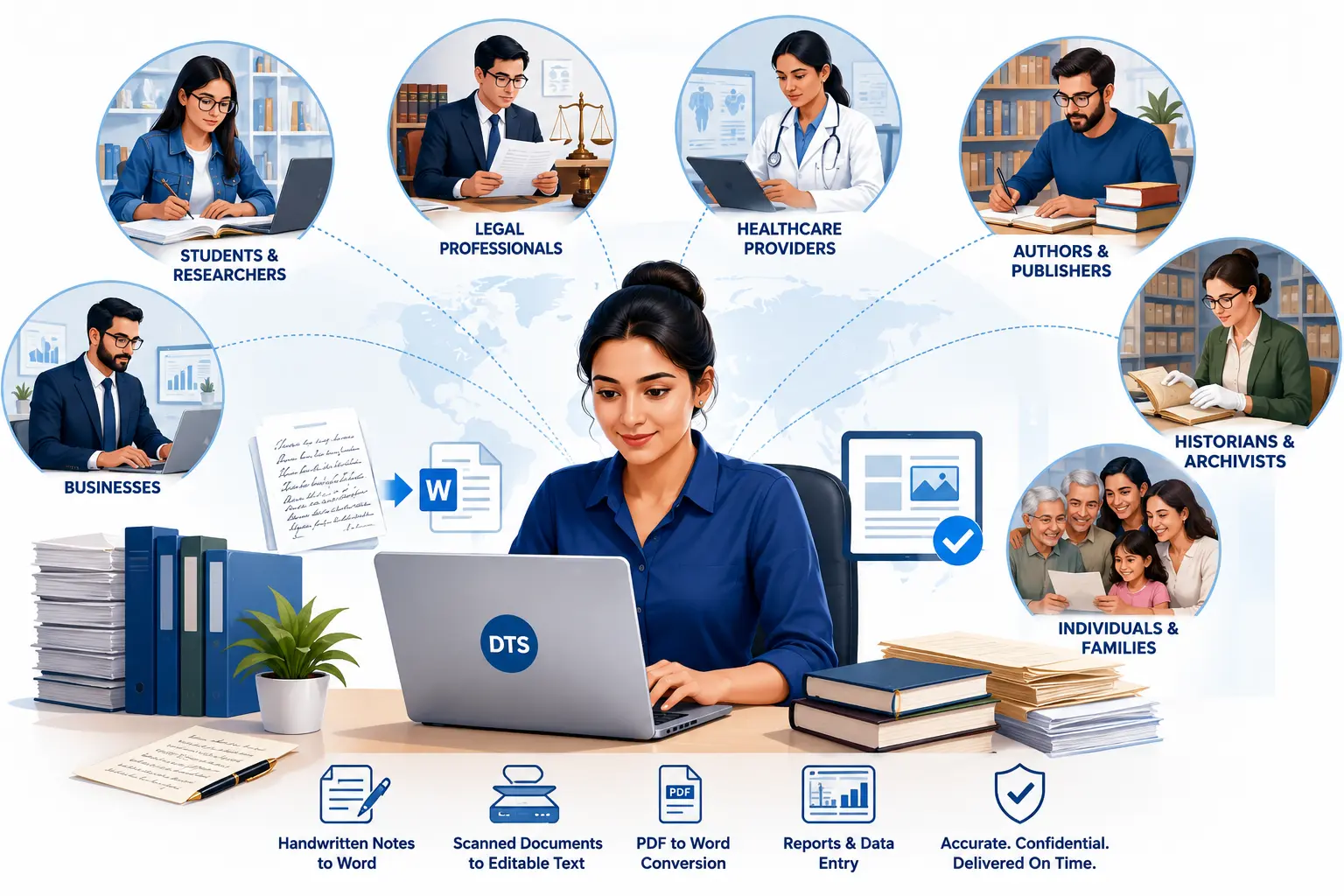
Professional typing services are used by a wide variety of people and organisations that need accurate, editable digital documents. While students and researchers often rely on typing services for theses and research materials, businesses, legal firms, healthcare providers, authors, historians, and individuals also depend on skilled human typists to convert handwritten notes, printed documents, scanned images, and PDFs into well-formatted digital files.
- Discover the industries and professions that regularly use professional typing services.
- Understand why human typing remains valuable alongside OCR technology.
- Learn which document types benefit most from manual transcription.
- Identify situations where professional typing improves accuracy, usability, and long-term document preservation.
- Find the most suitable typing solution for different personal, academic, legal, medical, and business needs.
Why This Article Matters
Many people associate professional typing services with simple data entry or document conversion. In reality, they support a much broader range of specialised work where accuracy, formatting, readability, and dependable human review are essential.
Whether you are preserving handwritten family letters, preparing an academic thesis, digitising historical records, managing confidential legal documents, or organising business reports, choosing the right approach can save time while producing digital documents that are easier to edit, search, share, and preserve for future use.
The following sections explore the diverse people, professions, and organisations that benefit from professional typing services and explain why manual expertise continues to play an important role in modern document digitisation.
An Overview of Typing-Service Users
Professional typing services are used by people and organisations that need accurate, editable digital documents while preserving the content, structure, and readability of the original material. Although these services are often associated with students or office work, they support a much wider range of industries and personal projects where precision and careful document handling are essential.
Clients may need to convert handwritten notes, printed pages, scanned images, PDF files, historical records, medical documentation, legal paperwork, or unpublished manuscripts into professionally formatted digital files. Each project has different requirements, but the common objective is to produce reliable documents that can be edited, searched, shared, archived, or prepared for future use.
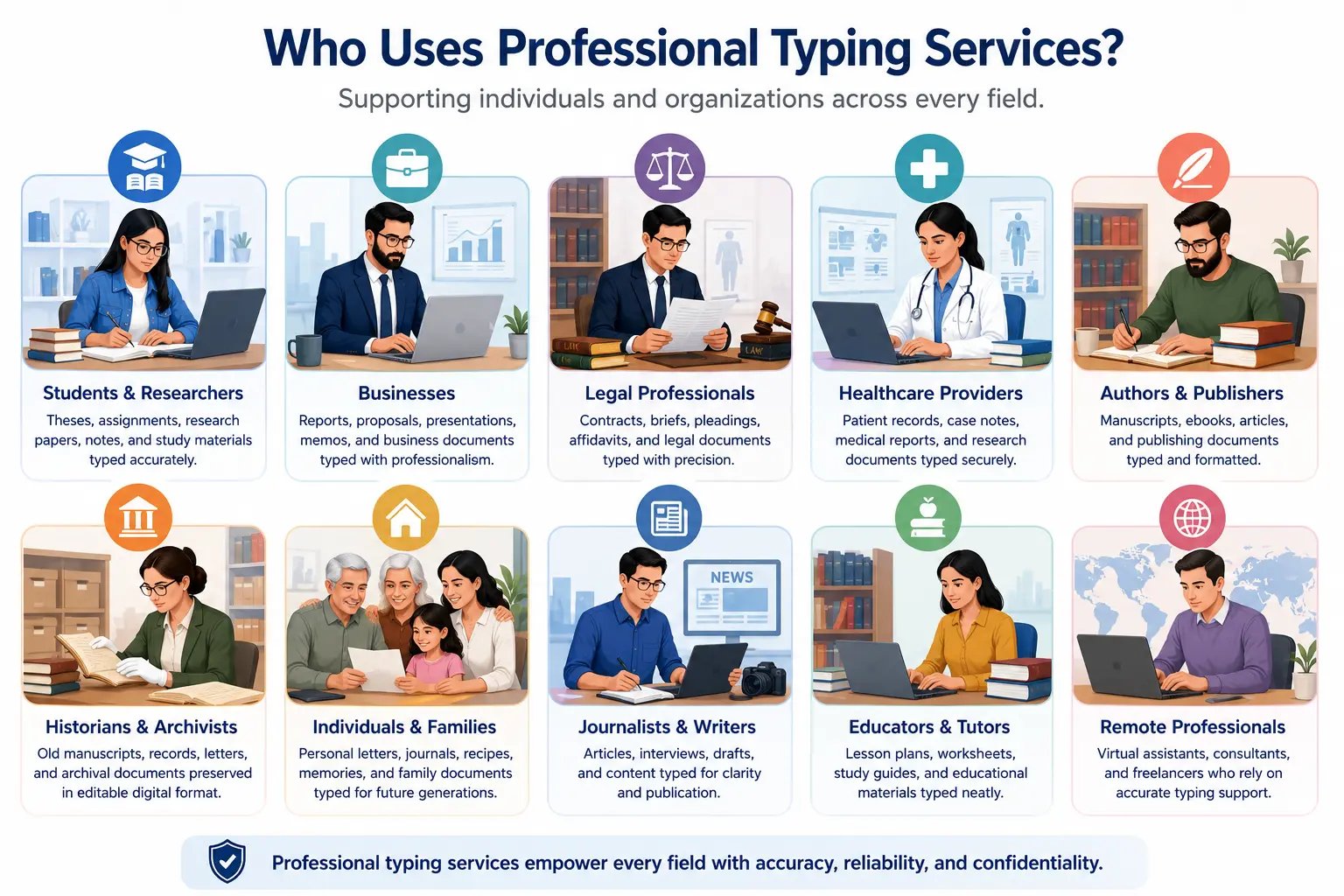
The following groups represent some of the most common users of professional typing services. While their documents and objectives differ, they all benefit from accurate human transcription and consistent document formatting.
Students & Researchers
Convert lecture notes, dissertations, research papers, surveys, laboratory records, and reference materials into organised, editable documents.
Businesses
Prepare reports, correspondence, operational records, forms, manuals, and other business documents for efficient digital workflows.
Legal & Healthcare Professionals
Digitise legal documents, case files, medical records, handwritten notes, and confidential documentation with attention to accuracy and formatting.
Authors & Publishers
Transform handwritten manuscripts, draft chapters, editorial revisions, and publication materials into editable digital files.
Historians & Archivists
Preserve historical documents, archival collections, family records, and heritage materials for future research and long-term access.
Individuals & Families
Preserve personal letters, diaries, certificates, recipes, memoirs, and other valuable documents in searchable digital formats.
Students & Researchers
Students, researchers, and academic professionals are among the most frequent users of professional typing services. Throughout a research project, they often accumulate handwritten notes, interview transcripts, laboratory observations, archival material, annotated references, and draft chapters that eventually need to become organised, editable digital documents.
While many academic documents begin as handwritten notes or printed source material, the final submission usually requires professionally formatted electronic files that are easy to edit, review, reference, and archive. Converting large volumes of information manually can be time-consuming, particularly when deadlines are approaching or research spans several months or years.

Academic Documents Commonly Submitted for Typing
- Lecture notes and classroom notebooks
- Research journals and laboratory records
- Dissertations and thesis drafts
- Interview transcripts and field notes
- Questionnaires and survey responses
- Historical reference material
- Handwritten citations and bibliographies
- Conference papers and seminar notes
Why Students Choose Professional Typing Services
Academic work demands consistency, clarity, and careful attention to detail. Professional typists can accurately reproduce handwritten content while maintaining logical document structure, allowing students and researchers to focus on analysis, editing, and final presentation rather than repetitive data entry.
This support becomes especially valuable for lengthy dissertations, collaborative research projects, handwritten field notebooks, or documents containing extensive annotations that require careful interpretation and organisation.
Related Service
If your project includes dissertations, research papers, thesis drafts, or other academic documents, our Academic Typing Service provides accurate manual typing with careful attention to document structure and formatting requirements.
Businesses
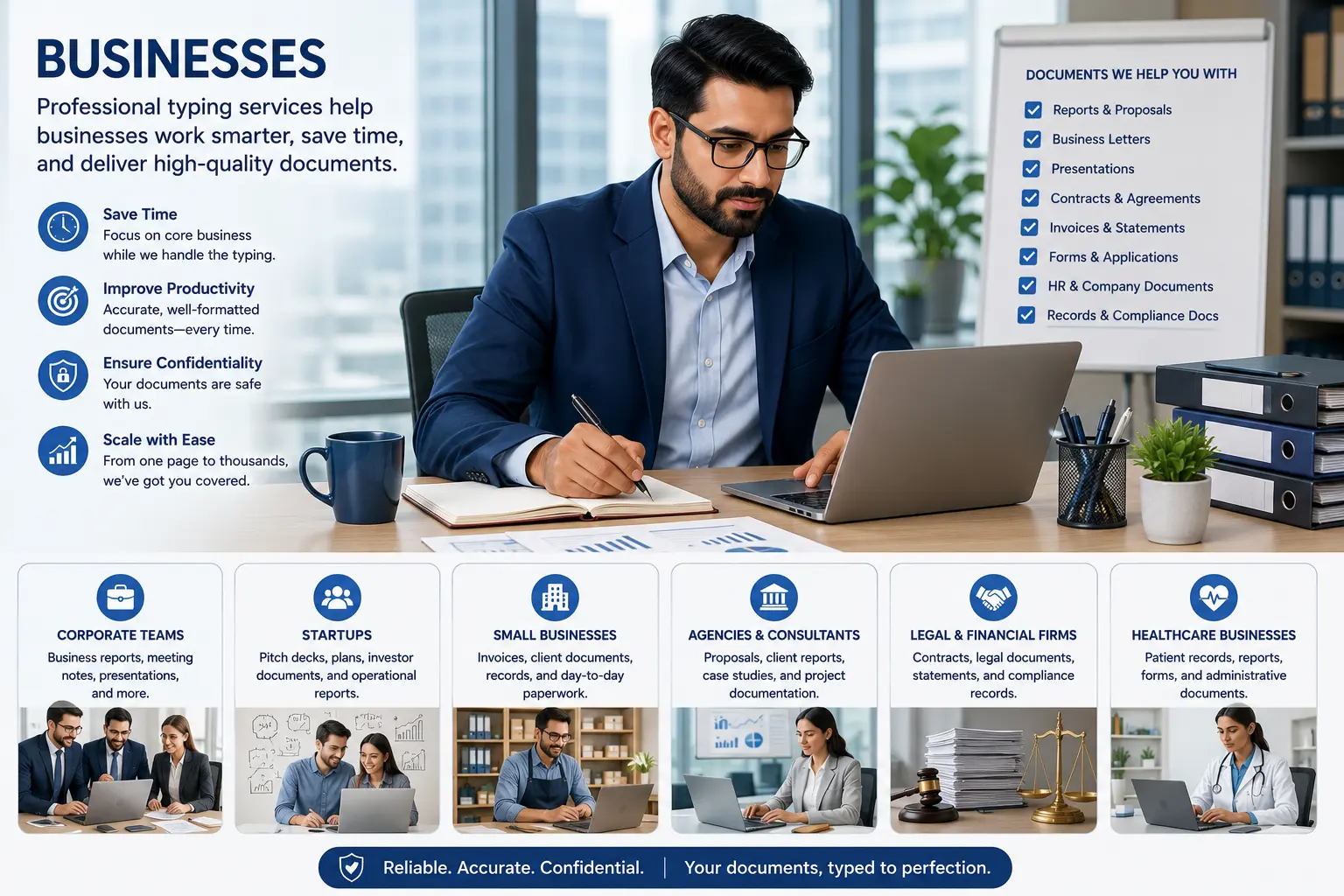
Businesses of every size rely on professional typing services to manage documents efficiently, improve record organisation, and reduce the time spent on repetitive administrative work. Whether preparing internal reports, digitising paper records, or converting archived documents into searchable digital files, professional manual typing helps organisations maintain accurate and well-structured business information.
While some companies require occasional document conversion, others outsource large-volume typing projects to improve productivity without diverting internal staff from their primary responsibilities. Professional typing services also provide a practical solution when legacy paper documents need to be incorporated into modern digital workflows.
Common Business Documents
- Business reports
- Meeting minutes
- Operational manuals
- Employee records
- Printed forms
- Business correspondence
- Invoices and administrative documents
- Archived paper records
Why Businesses Outsource Typing
- Reduce administrative workload
- Digitise legacy paper records
- Create searchable business archives
- Support document management systems
- Handle large one-time conversion projects
- Improve consistency across business documents
- Free staff for higher-value work
- Maintain professionally formatted records
For many organisations, professional typing is not simply about converting paper into digital text. It is an investment in better information management, operational efficiency, and long-term accessibility of important business records.
Related Services
Businesses often require a combination of document conversion solutions. Depending on the source material, our PDF to Word Typing Service, Scanned Image Typing Service, and Handwritten Typing Service can help convert paper-based information into professionally prepared digital documents.
Legal & Healthcare Professionals
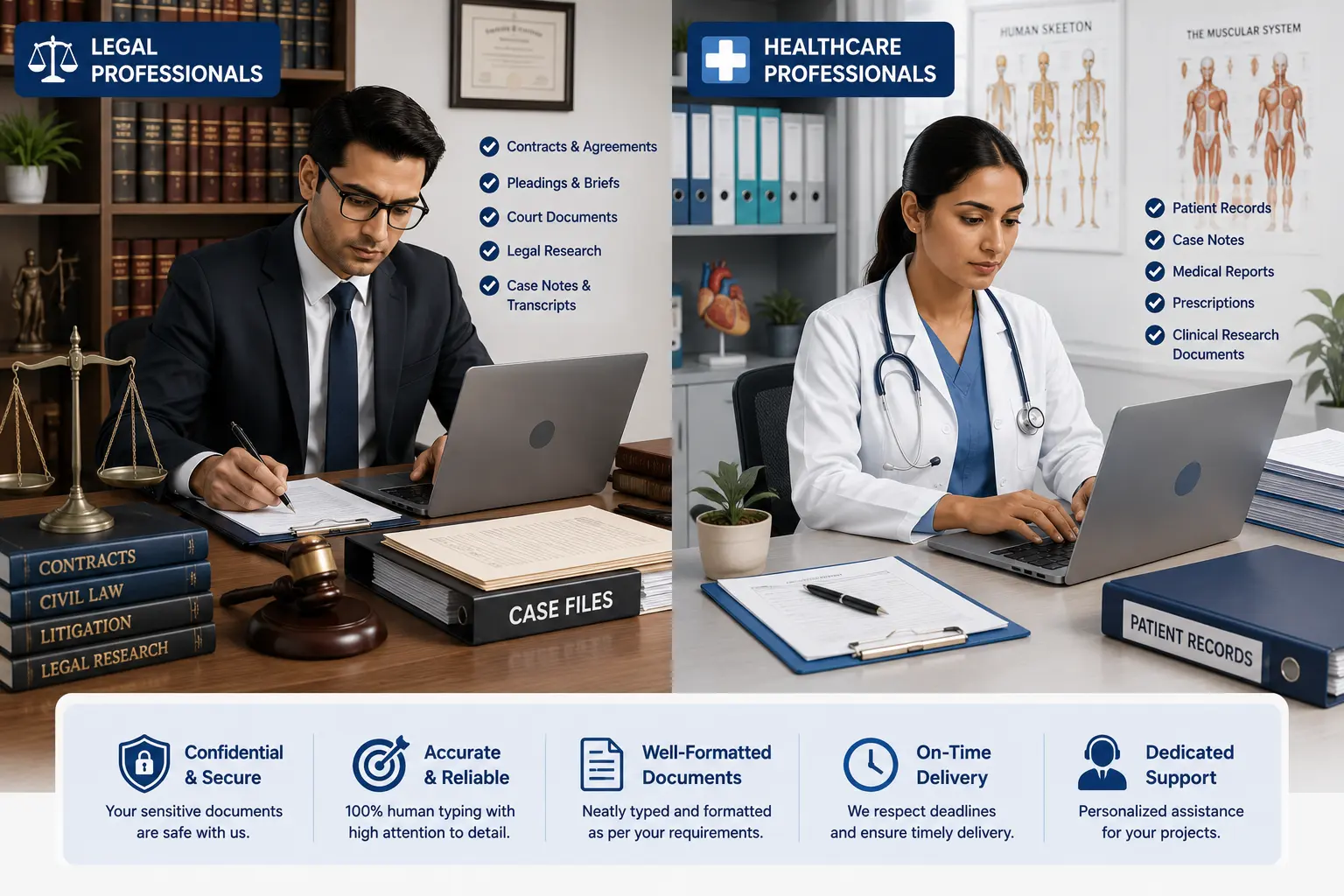
Legal practices and healthcare organisations regularly work with documents that require careful organisation, consistent formatting, and faithful transcription. Whether preserving handwritten records, digitising legacy paperwork, or preparing documents for long-term storage, professional typing services help convert important information into well-structured digital files that are easier to manage and review.
Although the types of documents differ between the legal and healthcare sectors, both fields often require precise reproduction of original content while maintaining the integrity and readability of the finished document.
| Legal Professionals | Healthcare Professionals |
|---|---|
| Contracts and agreements | Medical records and patient documentation |
| Case files and legal correspondence | Clinical notes and consultation records |
| Witness statements | Research data and medical reports |
| Court-related documents | Administrative healthcare documents |
| Archived legal records | Historical medical documentation |
Why Human Typing Matters
Documents in legal and healthcare settings frequently contain handwritten annotations, specialised terminology, structured layouts, or ageing paper records that require careful human interpretation. Professional manual typing focuses on faithfully reproducing the original content while preserving document structure and readability for future use.
Related Services
Organisations handling legal paperwork, handwritten records, scanned files, or printed documents may benefit from our Document Typing Services, Handwritten Typing Service, and Scanned Image Typing Service, depending on the source material and project requirements.
Authors, Publishers & Content Creators
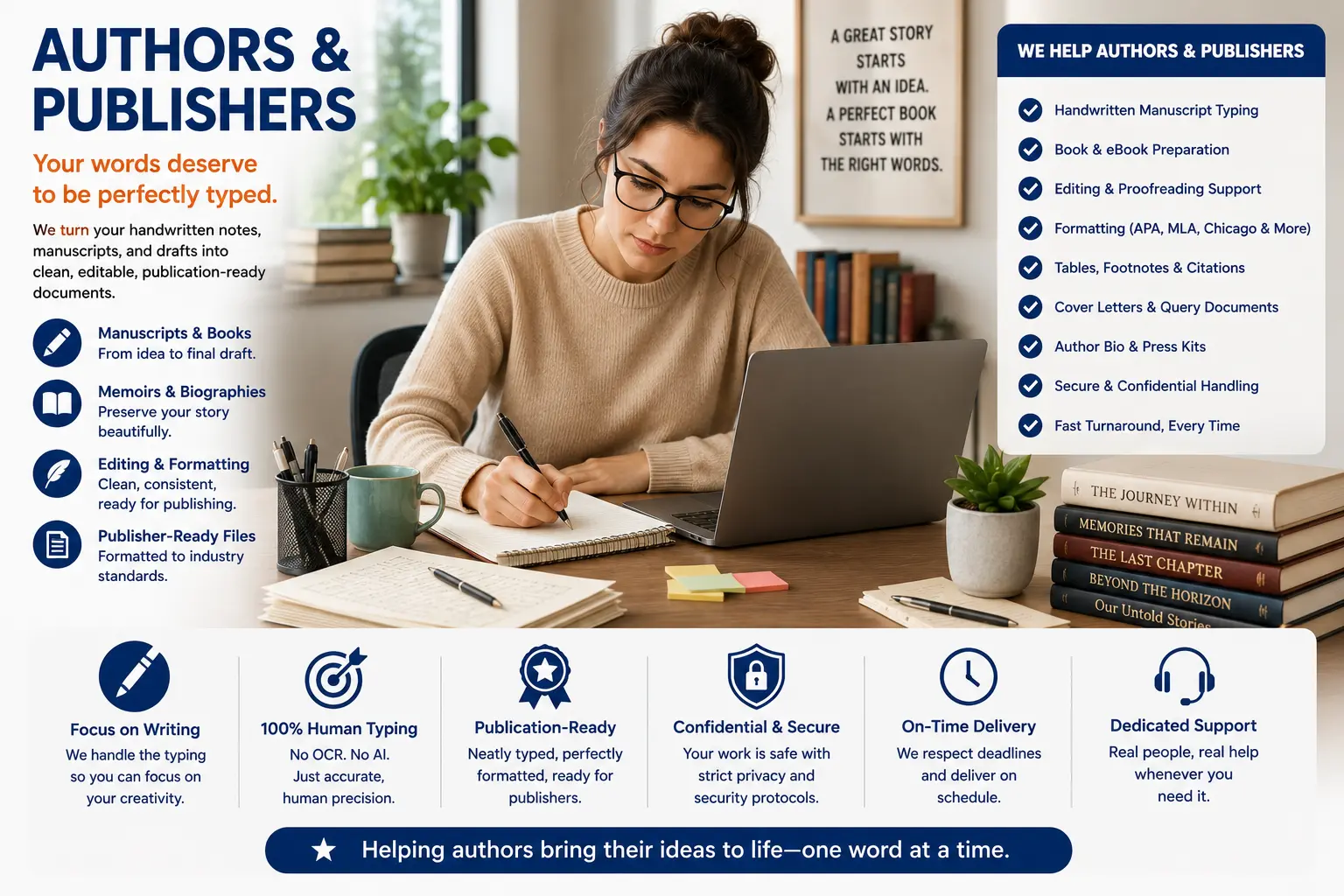
Writers, authors, publishers, journalists, and content creators often develop ideas in notebooks, handwritten drafts, printed manuscripts, or annotated proofs before producing a final publication. Professional typing services help transform these materials into well-organised digital documents that are easier to edit, revise, collaborate on, and prepare for publication.
Whether documenting a novel, autobiography, memoir, research publication, or training manual, converting handwritten content into editable files creates a more efficient workflow for authors, editors, and publishing teams while preserving the original material for future reference.
Step 1
Create handwritten notes, draft chapters, outlines, or manuscript pages.
Step 2
Convert the material into accurately typed and consistently formatted digital documents.
Step 3
Edit, review, collaborate with editors, and prepare the manuscript for its next stage of publication.
Documents Frequently Submitted by Authors
Professional typing services commonly assist with handwritten manuscripts, autobiographies, memoirs, novels, biographies, journals, speeches, training materials, editorial corrections, research publications, and other long-form written works that benefit from accurate digital conversion.
Related Service
Our Book & Manuscript Typing Service is designed for authors, publishers, researchers, and organisations that need handwritten manuscripts converted into professionally formatted digital documents suitable for editing, review, or publication.
Historians, Archivists & Genealogists
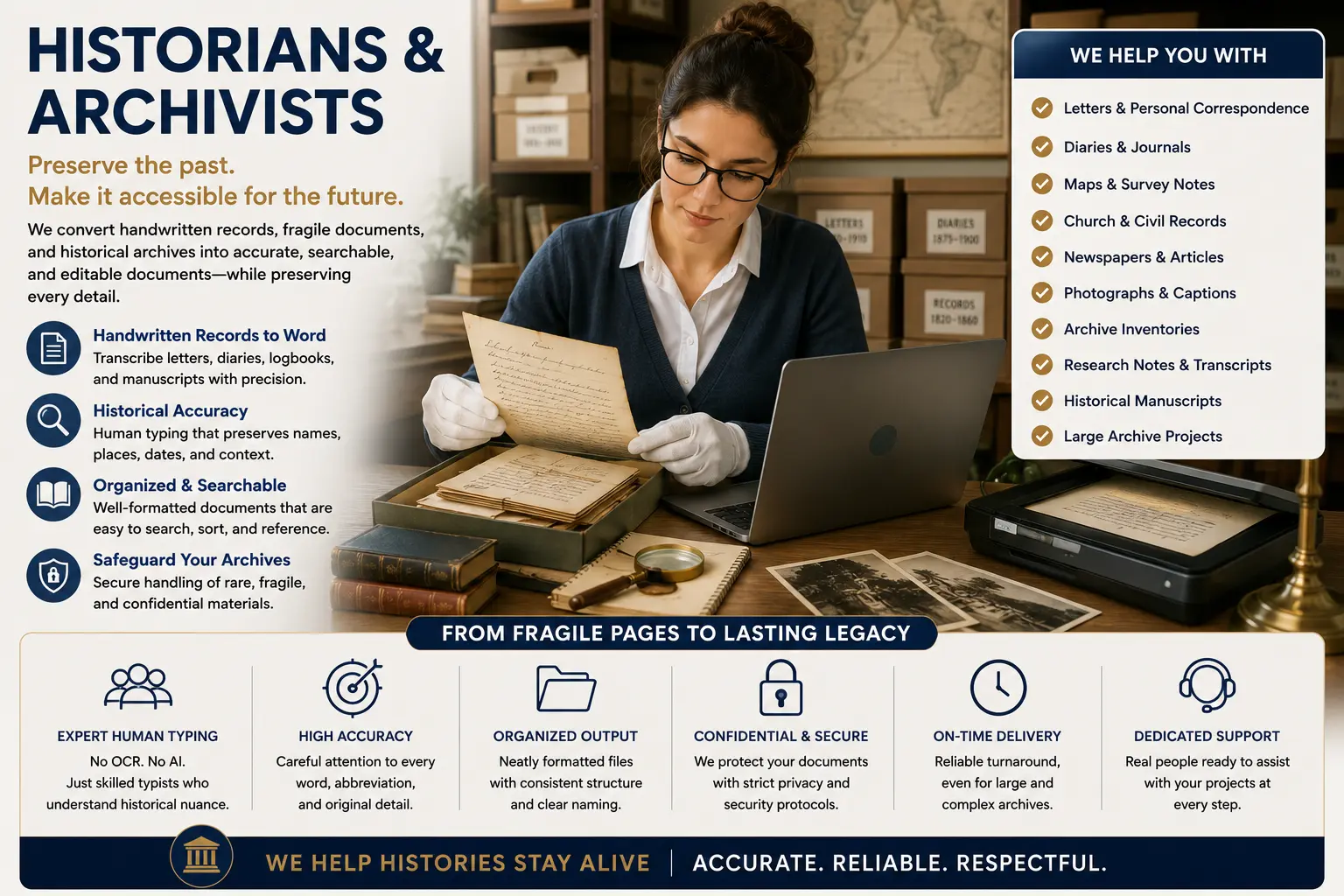
Historical documents often exist only as handwritten manuscripts, ageing paper records, personal correspondence, diaries, registers, or archival collections. Professional typing services help historians, archivists, genealogists, museums, libraries, and heritage organisations convert these valuable materials into organised digital documents that are easier to search, study, preserve, and share.
Unlike modern office documents, historical records frequently contain faded ink, older handwriting styles, fragile paper, or inconsistent formatting. Careful manual transcription helps preserve the original content while creating digital versions that support research, indexing, and long-term accessibility.
Why Historical Documents Are Commonly Typed
- Create searchable digital archives.
- Reduce handling of fragile original documents.
- Support historical and genealogical research.
- Improve document organisation and indexing.
- Enable easier sharing with researchers and family members.
- Preserve valuable information for future generations.
Examples of Historical Materials
Projects may include family letters, handwritten journals, church registers, census records, military documents, estate papers, local history collections, museum archives, unpublished memoirs, and other historical materials that benefit from accurate digital transcription while retaining the integrity of the original content.
Individuals & Families
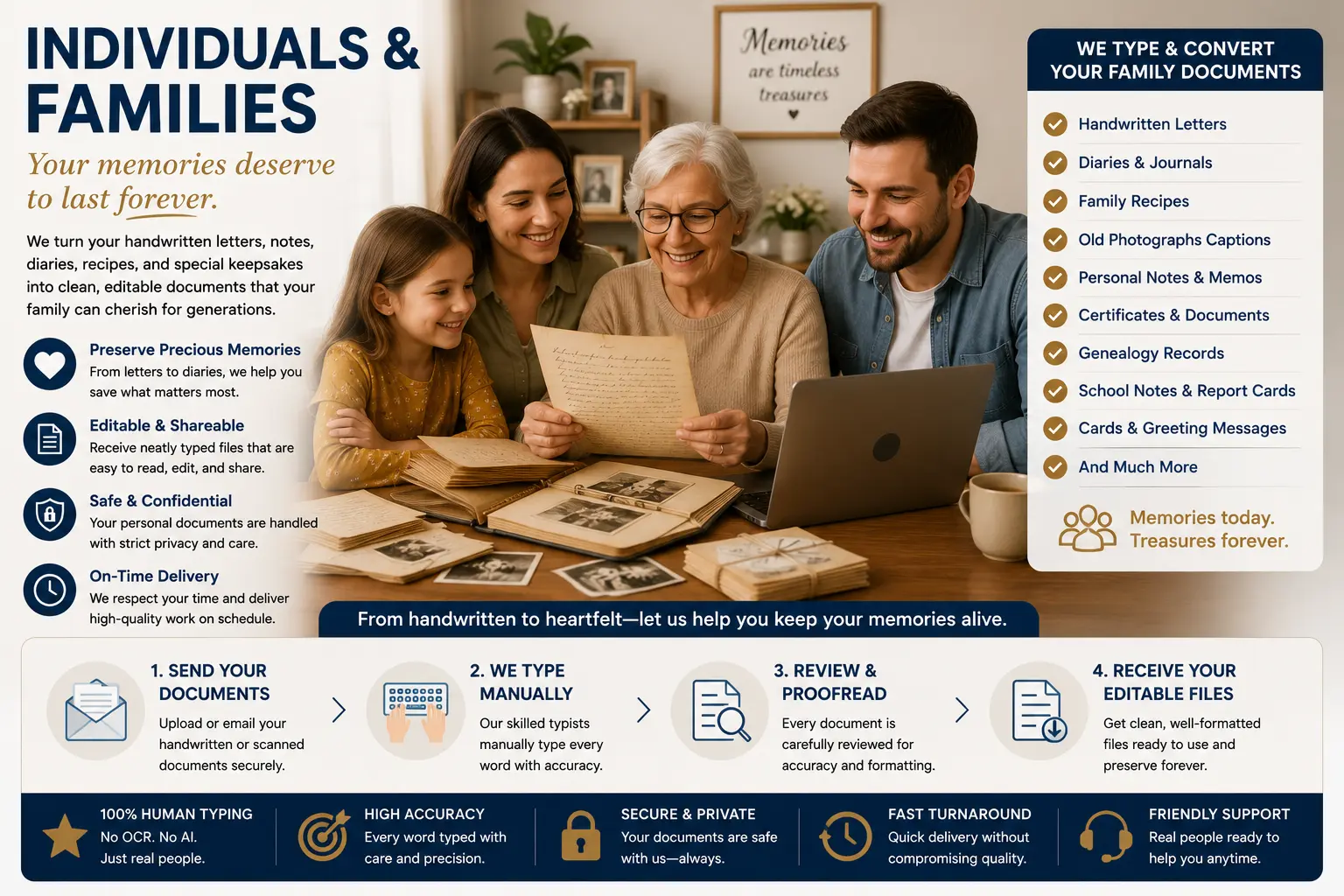
Professional typing services are not limited to businesses or organisations. Individuals and families also use them to preserve personal documents that hold sentimental, historical, or practical value. Handwritten letters, diaries, family recipes, memoirs, certificates, and personal records often become easier to organise, search, and share once they have been converted into carefully prepared digital documents.
Many personal collections contain ageing paper, fading handwriting, or fragile documents that are difficult to duplicate or replace. Creating an accurate digital version helps preserve the information while reducing the need to repeatedly handle valuable originals.
Personal Documents Commonly Converted
- Family letters and correspondence
- Personal diaries and journals
- Memoirs and autobiographies
- Handwritten recipes and cookbooks
- Certificates and personal records
- Family history and genealogy notes
- Speeches and commemorative documents
- Legacy documents for future generations
Every handwritten document tells a story. Converting it into a searchable digital format helps ensure that the information, memories, and experiences it contains remain accessible for future generations.
Why Professional Typing Services Are Still Relevant Today
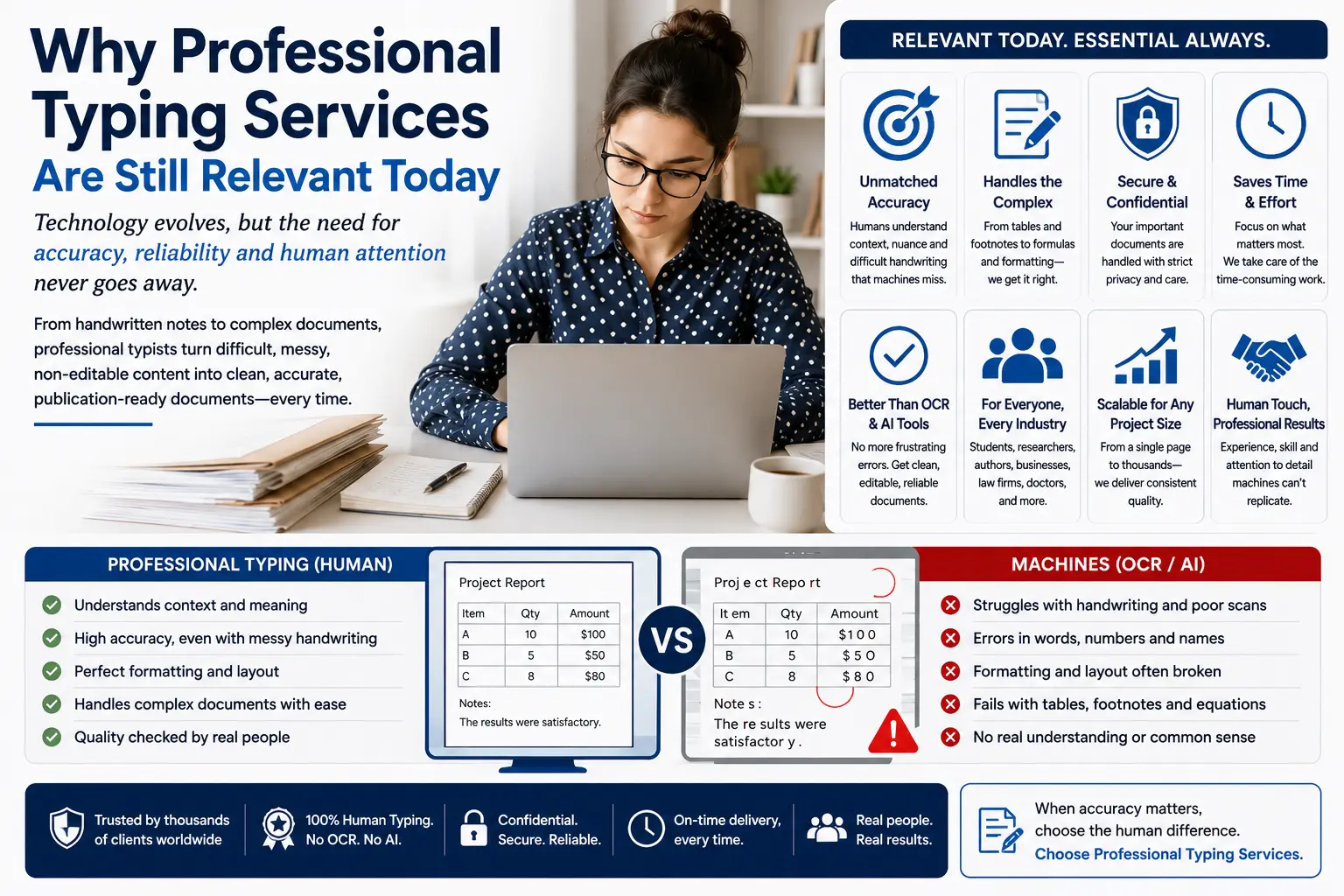
Advances in document scanning, Optical Character Recognition (OCR), and artificial intelligence have made it easier than ever to convert printed text into digital content. However, many real-world documents still require careful human review and manual transcription to produce reliable, well-structured results.
Handwritten notes, ageing paper records, annotated documents, complex layouts, and low-quality scans often present challenges that automated tools cannot consistently resolve without additional editing. Professional typing services remain valuable because they combine careful document handling with attention to formatting, readability, and faithful reproduction of the original content.
| Automated OCR | Professional Manual Typing |
|---|---|
| Works best with clear, high-quality printed text. | Can handle handwritten, printed, or mixed document sources. |
| May require post-processing to correct recognition errors. | Produces carefully reviewed digital documents during transcription. |
| Performance can vary depending on scan quality and layout. | Adapts to varied document formats and presentation styles. |
| Limited when dealing with faded text or handwritten annotations. | Suitable for documents requiring human interpretation and careful formatting. |
Choosing the Right Approach
OCR and professional typing are not competing solutions—they are complementary tools. OCR can be an efficient choice for clean, machine-printed documents, while manual typing is often more appropriate when documents contain handwriting, complex formatting, annotations, or content that requires careful human review. Selecting the right approach depends on the condition of the source material and the quality of the final document you need.
Key Takeaways
- Professional typing services support a wide range of industries, organisations, and individuals.
- Human transcription remains valuable for handwritten, historical, annotated, and complex documents.
- Accurate digital documents improve editing, organisation, collaboration, and long-term preservation.
- The best conversion method depends on the type and condition of the original document.
Frequently Asked Questions
Who typically uses professional typing services?
Professional typing services are used by students, researchers, businesses, legal professionals, healthcare organisations, authors, publishers, historians, archivists, and individuals who need handwritten, printed, scanned, or PDF documents converted into accurate, editable digital files.
What types of documents can be typed professionally?
Common documents include handwritten notes, manuscripts, reports, legal paperwork, medical records, dissertations, business documents, historical records, letters, diaries, forms, and scanned documents.
Are professional typing services only for businesses?
No. While businesses frequently use professional typing services, they are equally valuable for students, researchers, authors, families, historians, and anyone who needs documents converted into organised digital formats.
When is manual typing better than OCR?
Manual typing is often preferred for handwritten documents, faded text, complex layouts, annotated pages, and poor-quality scans where automated OCR may require significant correction.
Can professional typing preserve historical documents?
Yes. Professional typing creates accurate digital versions of historical materials that are easier to search, organise, archive, and share while reducing repeated handling of fragile originals.
Can handwritten documents be converted into editable files?
Yes. Professional typists manually convert handwritten content into editable digital documents while preserving the original wording and maintaining a clear, organised document structure.
What are the benefits of outsourcing typing work?
Outsourcing typing work can reduce administrative effort, improve document organisation, save time, and provide professionally prepared digital documents without diverting internal resources.
Do professional typing services help authors and publishers?
Yes. Authors and publishers often use professional typing services to convert handwritten manuscripts, draft chapters, editorial notes, and research materials into editable files for review and publication.
How should documents be prepared before typing?
Arrange pages in the correct order, ensure they are clearly legible, and provide any necessary instructions regarding formatting, abbreviations, or specialised terminology before submitting the documents for typing.
How do I choose the right professional typing service?
Consider the type of documents you need converted, whether they are handwritten, printed, scanned, or PDF files, the level of formatting required, expected turnaround time, and the provider's experience handling similar projects.
Final Summary & Key Takeaways
Professional typing services support far more than routine document conversion. They help students complete academic work, businesses organise information, legal and healthcare professionals manage important records, authors prepare manuscripts, historians preserve valuable archives, and families protect personal memories for future generations.
Although modern OCR and AI technologies have expanded the options for document digitisation, many projects still benefit from careful human transcription, particularly when source materials contain handwriting, complex layouts, annotations, ageing paper, or formatting that requires close attention. Selecting the most appropriate method depends on the type of document, its condition, and the quality of the final digital version you need.
Key Takeaways
- Professional typing services are used across education, business, legal, healthcare, publishing, historical research, and personal projects.
- Manual typing remains valuable for documents that require careful human review, accurate transcription, and consistent formatting.
- Different document types benefit from different conversion methods, making it important to choose the right approach for each project.
- Well-prepared digital documents improve editing, collaboration, accessibility, and long-term preservation.
- Understanding who uses professional typing services helps you select the solution that best matches your specific document requirements.
Every document has a purpose, whether it supports research, business operations, legal matters, publication, historical preservation, or personal memories. Choosing the right typing solution helps ensure that valuable information remains accurate, accessible, and useful for years to come.
Ready to Convert Your Documents?
Whether you're preserving handwritten memories, preparing an academic thesis, digitising business records, converting legal paperwork, or transforming a manuscript into an editable digital document, professional manual typing provides an accurate and reliable solution for a wide variety of document types.
At Dollar Typing Service, we specialise in human-powered document conversion with careful attention to accuracy, formatting, and document presentation. Every project is handled by experienced professional typists rather than relying solely on automated text recognition.